

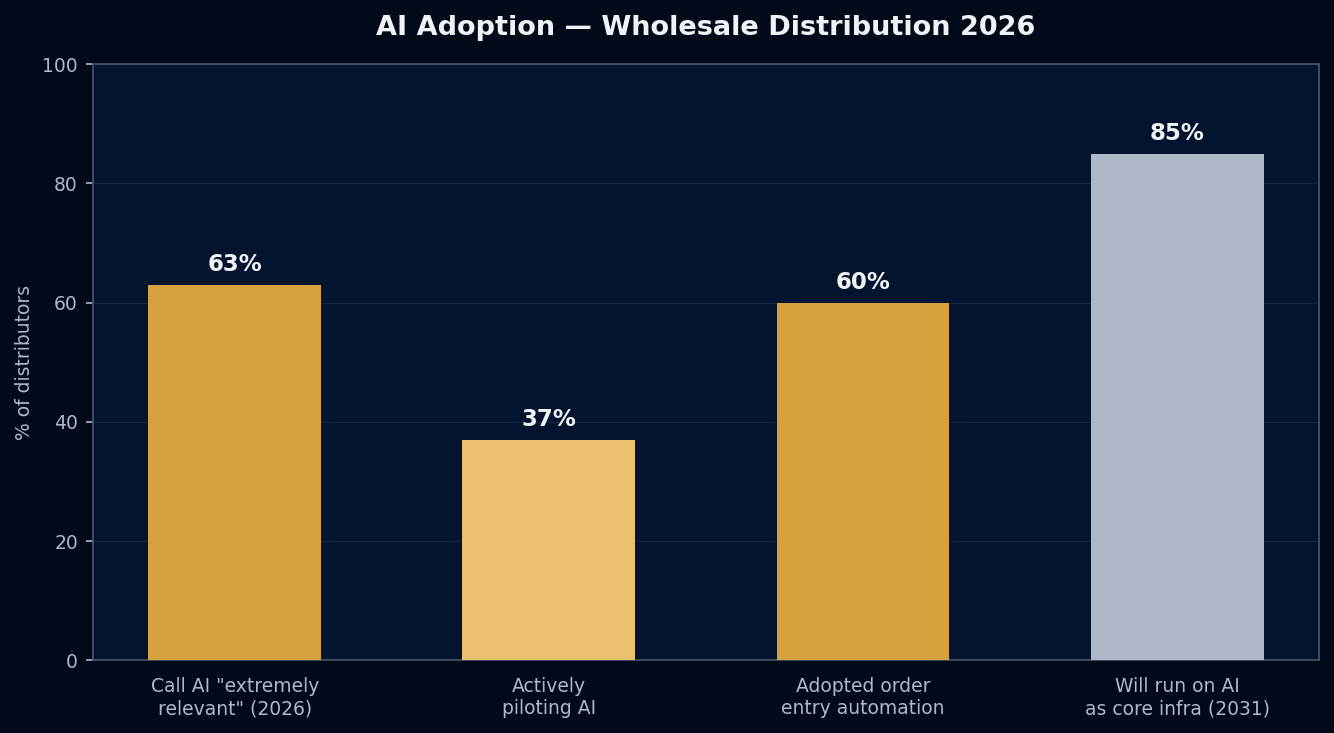
60% of wholesale distributors have adopted order entry automation (Epicor, 2026). The institutional benchmark for mature implementations — set by processors like Canals, which handles $5 billion in annual payables — is 96% touchless: 96 out of every 100 purchase orders processed without a human touching them.
The gap between where most distributors are and where the benchmark sits is real. This post explains what it takes to close it, what the economics look like at different scales, and who should actually be buying this technology in 2026.
What Order Entry Automation Actually Does
Order entry automation reads incoming purchase orders — in any format: PDF email attachment, plain-text email body, EDI file, WhatsApp message, web form — and enters them into your ERP automatically. Clean orders go through without human touch. Exceptions (missing SKU, out-of-stock item, pricing discrepancy) are flagged and routed to a human with context pre-loaded.
The efficiency gain is in both directions: clean orders process faster (under 60 seconds from receipt to ERP confirmation), and exceptions are resolved faster (the human sees the issue immediately, with the original order and the ERP discrepancy side by side).
The key output metric is the exception rate: the percentage of AI-processed orders that require manual correction. At 5% or below, the automation is generating net efficiency gains. Above 5%, manual handling of exceptions consumes more time than the automation saves. At 96% touchless, the exception rate is 4%.
The Three Layers Required
Reaching a sub-5% exception rate requires three functional layers:
Layer 1: ERP integration with clean SKU data. The AI reads incoming order lines and maps them to your ERP’s SKU catalog. If your ERP has inconsistent SKU naming — the same product listed as “Monin Elderflower 700ml,” “MONIN-ELD-700,” and “MON EFW 0.7L” in different records — the AI will generate false exceptions for order lines that are actually clean. SKU normalization (standardizing all variant names to a canonical identifier) is the prerequisite that most operators underestimate.
Layer 2: AI extraction with confidence thresholds. A model reads the incoming order document and extracts structured data: line items, quantities, unit prices, delivery instructions. The model assigns a confidence score to each extracted field. High-confidence extractions proceed automatically; low-confidence fields are flagged for human review. The threshold — how confident the model needs to be to proceed — is a configuration decision that trades throughput against exception rate.
Layer 3: Exception routing with context. Flagged orders land in a queue with: the original order document, the extracted data the AI produced, the ERP response (e.g., “SKU not found” or “price mismatch”), and a suggested resolution. A human resolves the exception in 30 seconds rather than 3 minutes of investigation. This layer determines whether exceptions are a manageable overhead or a bottleneck.
The Economics at Different Scales
Small distributor (50–200 customers, 10–30 orders/day):
Manual processing: 5–15 min per order × €36/hr fully-loaded = €3–€9 per order. At 20 orders/day: €60–€180/day, €15,600–€46,800/year.
AI processing (after implementation): €1–€2 per order including tool cost. At 20 orders/day: €20–€40/day, €5,200–€10,400/year.
Net saving at this scale: €10,000–€36,000/year.
Tool cost options for this scale: Mid-market tools like Order.co, Conexiom, or a custom Claude API integration with Zapier. Pricing at €150–€500/month ($1,800–$6,000/year). Payback period: 1–4 months.
Medium distributor (200–1000 customers, 50–200 orders/day):
At 100 orders/day and €6 average processing cost: €600/day, €156,000/year in processing cost. AI at €1.50/order: €150/day, €39,000/year.
Net saving: ~€117,000/year. Enterprise tool tier justified. Implementation investment of €15,000–€50,000 pays back in 2–6 months.
Who Should Buy It in 2026
AI order entry has a clear use-case fit profile:
Good fit: B2B distributors receiving purchase orders in multiple formats (email PDF, plain text, WhatsApp, web form) from customers who do not use EDI. If your order intake is format-inconsistent, AI extraction handles the variability that EDI mandates cannot.
Good fit: Operations where order entry is a daily time constraint — the team spends 2–4 hours per day on data entry and this creates a processing backlog.
Poor fit: Businesses where all customers use EDI and orders arrive in structured format directly into the ERP. If EDI is working, you have effectively already solved this problem.
Poor fit: Operations with very high SKU variability and inconsistent catalog naming. The AI will generate high exception rates until the SKU problem is fixed. Invest in ERP data quality first.
Borderline: Small distributors (<10 orders/day). The ROI math works but the payback period is longer. If the primary pain is not order volume but order complexity — many line items, many custom pricing tiers — the complexity argument for AI is stronger than the volume argument.
The Implementation Sequence
- Audit your order intake: count formats (PDF, email text, WhatsApp), average line items per order, and current exception rate in manual entry.
- Audit your ERP SKU data: identify the top 100 SKUs by order volume and check naming consistency. If there are more than 3 variant names per top-100 SKU, clean these first.
- Select tool based on scale and budget (see above).
- Start with a single order source (e.g., email PDF only). Get exception rate below 5% before adding WhatsApp and other channels.
- Add exception routing with context. Monitor daily for the first two weeks.
- Scale to full order intake once exception rate is stable.
The most common mistake: trying to automate all order sources simultaneously before validating the exception rate on one source. Start narrow, validate, expand.
AHoosh builds order entry automation implementations for B2B distributors. Contact: ahoosh.ai/contact